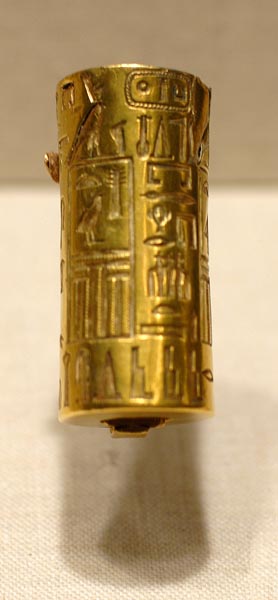
Gold seal of office, 5th Dynasty reign of Djedkare Isesi (reigned 2414-2375 BC) [68.115], reported to be made from Northwest Anatolia Gold.
Cylinder seals hearing royal and private names with titles are known from both the Early Dynastic Period and the Old Kingdom. They are typically made of stone, but there are also some examples fabricated from gold and silver. Among those, however, a sound context is rare. The provenance of this seal-unique in its size and state of preservation-is uncertain. The seal is classified as a "seal of office," which is always anonymous. It contains the name of the reigning King Djedkare Isesi, and official titles, but no personal name. When the office represented by the titles was passed on to a successor, the seal was handed over to that individual, but when the king's reign changed, the seal was no longer valid. Cylinder seals of this type were used to identify documents, boxes, provisions, and even doors. A relief from the pyramid temple of King Sahure at Abusir illustrates their standard form during the Old Kingdom: long, with a biconcave body (see illustration at left).
While most precious metal examples are made from sheet metal with a chased surface decoration over a core, this piece stands out because it was constructed of cast cylinders that were subsequently decorated. The gold from which the cylinder was created has a high copper content, suggesting to some scholars that it was not of Old Kingdom date. However, with recent analysis of excavated gold samples from Giza, it can now he shown that the copper content is within the normal range for that time and place.
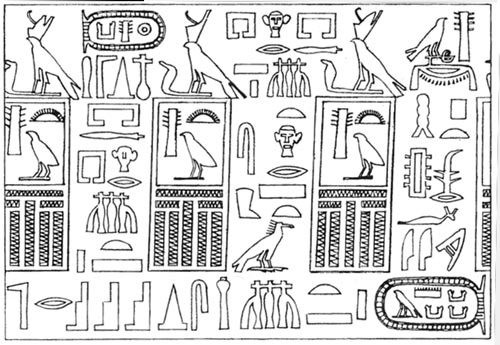
Boston Museum of Fine Art. Source: Egypt in the Age of the Pyramids; Yvonne Markowitz, Joyce Haynes
and Rita Freed; MFA Publications; 2002
Contact & Feedback : Egyptology and Archaeology through Images : Page last updated on 09-November-2025